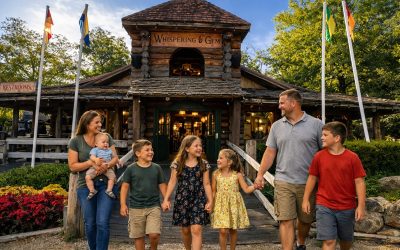

When was the last time your family stood somewhere and said, “Wow”? A place can do that before anyone explains its history. At Majestic Caverns in Childersburg, Alabama, the scale of the cave prompts wonder first. Then the record opens a window onto the early years of the United States.
In 1796, Benjamin Hawkins documented the caverns while serving as the U.S. Superintendent of Indian Affairs. George Washington was president at the time. The distinction matters: Hawkins made the record; Washington did not visit or write about the cave. That careful wording lets the story be both compelling and credible.
What the 1796 record tells us
Hawkins’s writing places Majestic Caverns within the documentary record of the young federal government. The account belongs to a period when the new nation was still defining its institutions and relationships. It is a remarkable connection for an Alabama cave, but it is one chapter in a much longer human story.
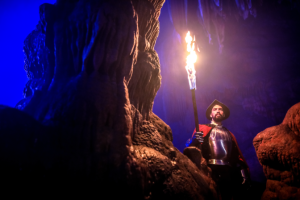
People had used the cave long before 1796. Archaeological findings connect it to Woodland-period Indigenous history and Copena burial traditions more than 2,000 years ago. The region also carries colonial-era history, including de Soto’s passage through the area in 1540. Later, the cavern was tied to saltpeter activity during the Civil War. Since Ida Mathis purchased the property in 1912, six generations of her family have cared for the site and kept it open to visitors.
That continuity is part of the America 250 story. The cave has remained a real place through changing eras, while people’s reasons for encountering it have changed. Today, families can enter, learn, and experience a natural landmark whose record reaches back to the founding period.
America 250 gives families an opportunity to look at the country’s beginnings from more than one angle. The Hawkins record connects the cave to the young federal government, while the archaeological evidence points to people who knew this landscape millennia earlier. Both belong in a full account of the place. The cavern lets visitors meet those histories where they happened, then think about how land and memory continue across generations.
Quick facts
- Location: Majestic Caverns, Childersburg, Alabama; formerly DeSoto Caverns.
- Documented record: Benjamin Hawkins described the cave in 1796.
- Presidential context: The record dates to George Washington’s presidency.
- Earlier history: Archaeological evidence documents Indigenous use more than 2,000 years ago.
- Later history: Civil War-era saltpeter activity and family stewardship beginning in 1912.
- Important wording: Do not say George Washington personally visited the cave or authored Hawkins’s account.
For writers and editors
Use: “Benjamin Hawkins documented Majestic Caverns in 1796, during George Washington’s presidency.” The site’s America 250 page provides an overview of the cave’s Indigenous, founding-era, Civil War, and preservation history. For interview requests, photographs, or additional background, contact press@MajesticCaverns.com or visit the press resources page.
For families, the history becomes even more meaningful when it is connected to the place itself. The guided tour lasts just under an hour, and the cave remains near 60 degrees year-round. Bring your curiosity, then stand in the same natural chambers that held people’s attention across centuries.
Frequently asked questions
Who recorded Majestic Caverns in 1796? Benjamin Hawkins, then the U.S. Superintendent of Indian Affairs.
Did George Washington visit the cave? No. Washington was president when Hawkins made the 1796 record; the documented account is Hawkins’s.
Why is the record relevant to America 250? It connects an Alabama landmark with the early federal period while making clear that Indigenous history at the site reaches back far earlier.
Can writers request photographs or an interview? Yes. Contact press@MajesticCaverns.com for media requests and visit the press resources page for background.