
At Majestic Caverns, you may have heard this phrase:
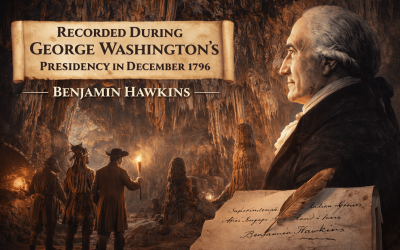
“Recorded during George Washington’s presidency.”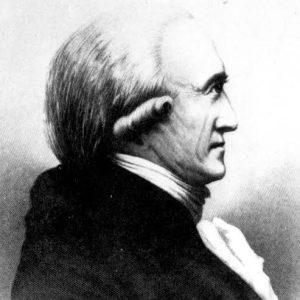
It’s a powerful statement.
It’s also one we use carefully.
In an age where history is often exaggerated, misquoted, or flattened into headlines, we believe clarity matters. This article explains exactly what that phrase means — and why it is historically accurate.
First, What It Does Not Mean
Let’s begin with what we are not saying.
George Washington did not visit the cave.
There is no historical evidence that George Washington ever traveled to this region or physically entered the cavern.
That distinction matters.
We do not claim presidential visitation.
We do not claim a personal endorsement.
We do not claim Washington stood beneath the Cathedral ceiling.
What It Does Mean
The accurate statement is this:
The cave was formally documented by a federal officer appointed under George Washington’s administration.
In December 1796, Benjamin Hawkins — who served as the United States General Superintendent of Indian Affairs — visited the cave.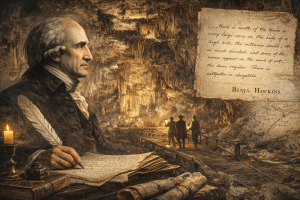
Hawkins was not a casual traveler.
He was a federal official appointed during Washington’s presidency and tasked with overseeing Native American affairs south of the Ohio River.
During his visit, Hawkins:
-
Entered the cave with Creek guides
-
Described its chambers and formations
-
Noted the presence of saltpeter (later mined during the Civil War)
-
Recorded his observations in official correspondence
Those writings were submitted during the Washington administration and later archived in federal records.
That is what “recorded during George Washington’s presidency” means.
Why This Matters Historically
This documentation places the cavern among the earliest federally recorded natural sites in the United States.
For context:
-
Alabama was not yet a state.
-
The nation was still in its Founding Era.
-
The federal government itself was less than a decade old.
And yet, this cave was formally described by a federal officer acting under presidential authority.
That is not folklore.
That is documented early American history.
Independent historical sources affirm this record. The Encyclopedia of Alabama notes the 1796 reporting under Washington’s administration
Majestic Caverns – Encyclopedia…
, and national cave registries reference Hawkins’ 1796 report as the first official federal documentation of the cavern
Show Caves of the United States…
.
Why We Clarify the Language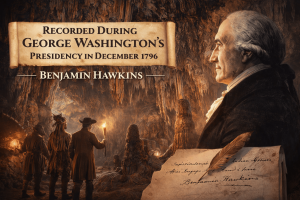
Precision builds credibility.
When we say:
“Recorded during George Washington’s presidency”
we mean:
-
Documented in 1796
-
By a federally appointed officer
-
During the administration of the first U.S. president
We do not mean:
-
Washington toured it
-
Washington claimed it
-
Washington designated it personally
Clear language protects the integrity of the story.
And integrity matters — especially as America approaches milestone anniversaries like the 250th.
A Broader Historical Arc
The 1796 federal documentation is one chapter in a much longer story:
-
Woodland-period Native American burials dating back roughly 2,000 years
-
Exploration-era encounters during the expedition of Hernando de Soto
-
Civil War saltpeter mining
-
Prohibition-era speakeasy activity
-
Purchase in 1912 by Ida Elizabeth Brandon Mathis, a nationally recognized agricultural reformer
Ida Elizabeth Brandon Mathis – …
-
Continuous family stewardship into the present day
Few natural sites in America carry documented connections to so many defining eras of the nation’s development.
Why This Is a Credibility Builder
Some organizations lean into myth.
We lean into documentation.
By clearly stating what happened — and what did not — we protect:
-
Journalistic accuracy
-
Educational integrity
-
Long-term brand trust
-
Historical scholarship
Intellectual honesty is not a liability.
It is a strength.
When media outlets, educators, and historians evaluate claims, they look for nuance. They look for restraint. They look for clarity.
That is why we use this phrasing carefully.
In Summary
George Washington did not visit the cave.
However:
-
The cave was formally documented in 1796
-
By a federal officer appointed under his administration
-
During his presidency
-
In official government correspondence
That distinction is historically accurate — and profoundly significant.
At Majestic Caverns, we do not need to embellish history.
The documented truth is remarkable enough.