Intro overview
In the American Civil War, industrial shortages shaped strategy as surely as troop movements. Few materials illustrate this more clearly than saltpeter, the nitrate component needed to manufacture gunpowder at scale. When Confederate supply lines tightened under blockade and battlefield demand surged, the South turned to local landscapes for what it could not reliably import. Caves, with their nitrate rich soils, steady temperatures, and sheltered interiors, became practical sites for wartime extraction.
Majestic Caverns in Childersburg, Alabama, preserves physical evidence of that resource economy. The value of the site to researchers is not rooted in legend or spectacle, but in the survival of mining features that can still be pointed to, described, and interpreted as part of a wider Southern industry of nitre production. The cave’s Civil War story can be read in the built traces of labor: a leaching setup, an original trough and ditch, and a hand dug well tied to the water intensive chemistry of nitrate processing.
What saltpeter is
In historic usage, “saltpeter” is a broad term for nitrate salts used to produce gunpowder. In the cave mining context at Majestic Caverns, the nitrate described and extracted from cave soil is calcium nitrate.
Calcium nitrate itself is not the end product most arsenals wanted. Gunpowder formulae typically required a nitrate that would behave predictably in refining and mixing. That is why historical nitrate operations frequently involved conversion steps: calcium nitrate in solution could be processed and transformed into other nitrate forms suitable for powder manufacture. The on site interpretation at Majestic Caverns explicitly notes this continuity of chemistry and conversion: cave soil was mined for calcium nitrate, which “can be processed into potassium nitrate,” the nitrate commonly associated with gunpowder recipes.
Civil War mining context
By the mid war years, the Confederacy faced persistent constraints in powder production. Even when the South could field men, it could not fight without a dependable stream of ammunition, and ammunition depended on nitrates. Nitre works and cave mining expanded across the South as a stopgap industrial network, often relying on small crews, improvised infrastructure, and a combination of household knowledge and military supervision.
Caves mattered because they offered three advantages that surface sites could not guarantee. First, cave soils could accumulate nitrates over long periods where organic inputs (including animal waste) contributed nitrogen compounds to the sediment. Second, caves provided a controlled environment, reducing weather interruptions and allowing predictable work conditions. Third, caves often had internal or nearby water sources, crucial because nitrate production depends on dissolving nitrates into solution and then recovering them through evaporation and crystallization.
The Majestic Caverns Civil War features align with that known workflow. The preserved components point to a process built around leaching and water handling rather than simple “dig and carry” extraction. The result is an interpretive record that is industrial in character: a sequence of tasks tied to chemistry, not merely to excavation.
Evidence inside the cave
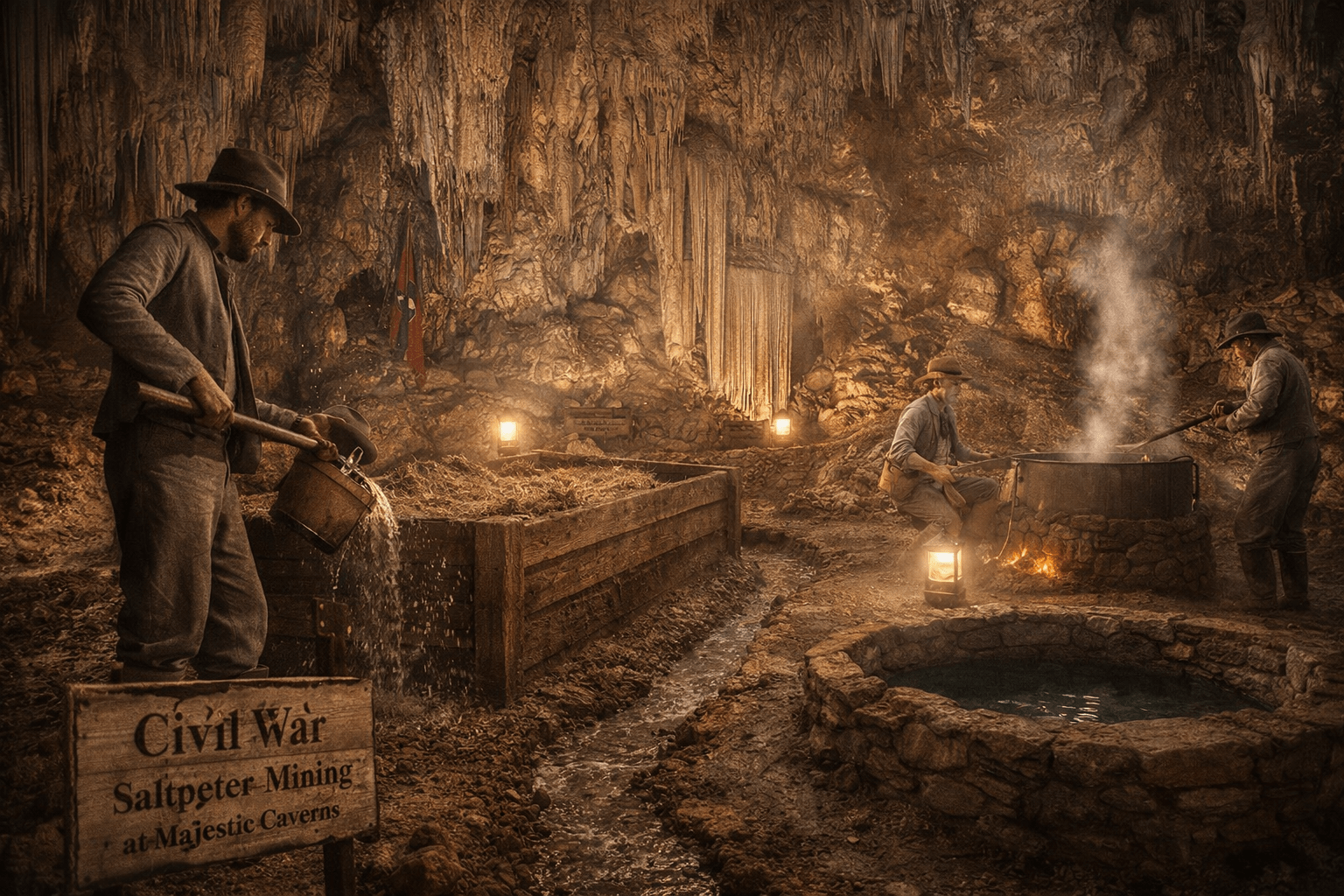
The most direct evidence at Majestic Caverns is the leaching system described in the tour interpretation and anchored in the cave’s physical remnants. In 1864, the account describes Confederate era work organized around mining cave soil for calcium nitrate and running it through a leaching vat.
The leaching setup is described with operational detail consistent with nineteenth century nitrate practice. A filter layer (hay) was placed in the vat, then a layer of soil was added, and water was poured through to dissolve soluble nitrates into a liquid “mother liquor.”
The outflow did not simply spill onto the cave floor; it moved into a defined channel identified as the original ditch or trough associated with the operation.
This matters for researchers because a trough and controlled channel imply repeatable production, not a one off experiment. The trough indicates forethought in managing flow, collecting leachate, and keeping the process efficient. The interpretation also notes the next steps: the liquid was carried out for boiling, charcoal was added to introduce needed chemical components, and the solution was reduced until niter crystals remained.
Even if the above ground boiling equipment does not survive in place, the cave side features document the interior half of the production chain.
Equally important is water. The cave preserves a feature interpreted as the Confederate Well, explicitly described as enabling gunpowder mining to occur because the operation required a dependable water supply.
The well is described as fed by an underground spring that “would never run dry,” a statement that underscores why this location could support sustained leaching work.
When combined with the presence of the trough and leaching area, the well forms part of a coherent industrial layout: a source of water, a place to leach soil, and a channel to move solution.
The visible “trenches and wells” associated with saltpeter mining are therefore not abstract claims at Majestic Caverns. They are tangible, identifiable elements of a workflow, still pointed out in the cave today: the original trough and leaching ditch, and the Confederate era well.
Continuity with Hawkins and earlier nitrate awareness
Majestic Caverns’ Civil War mining episode did not emerge from nowhere. Long before the 1860s, educated travelers and officials noted nitrate presence in regional limestone landscapes. In the late eighteenth century, Benjamin Hawkins, U.S. agent for Indian affairs, recorded observations in the broader Creek country that included references to saltpeter in cave contexts. In the Hawkins correspondence you provided, he describes a “very large cave” and notes “saltpeter in crystals,” demonstrating that nitrate deposits were noticed, described, and considered meaningful well before the Civil War’s industrial crisis.
For historical interpretation, this continuity is significant. It frames Civil War mining not as a sudden curiosity, but as the wartime mobilization of a resource already known to exist in the karst environment. In other words, the Civil War did not create the nitrate; it created the urgency and organization to extract it.
Why it matters historically
Saltpeter mining is a clear case study in how natural resources shaped wartime economies. The Civil War South relied on local production networks for essentials when external trade was restricted. Nitre became a strategic commodity, and caves became part of an improvised industrial landscape that linked geology, chemistry, labor, and military demand.
Majestic Caverns matters because it preserves the physical record of that relationship. A leaching vat, trough, and spring fed well are not symbolic artifacts; they are evidence of process and logistics. They point to labor organization, to the prioritization of powder supply, and to the practical knowledge required to turn cave soil into usable nitrate crystals.
For educators and researchers, the site offers a grounded way to teach wartime industry beyond factories and railroads. It shows how “industry” in the Confederacy could be dispersed, hidden, and dependent on landscapes that predated the war by millennia. It also invites careful distinctions between verifiable evidence and later storytelling: the strongest historical claims at Majestic Caverns are those that can be tied to features still present in the cave.
The Civil War use of the caverns reflects a documented pattern of federal and military awareness of the site that predates the conflict. Earlier federal references—including those recorded during George Washington’s administration—establish the cave as a known and evaluated natural resource well before the nineteenth century. These records are preserved and contextualized within Majestic Caverns’ broader historical documentation.
Documentation & Historical Context
The Civil War saltpeter mining features preserved inside Majestic Caverns are part of a larger body of documented history associated with the site. Additional primary sources, federal references, and interpretive materials related to the cave’s earlier naming as DeSoto Caverns and its role in American history are maintained as part of Majestic Caverns’ public historical record.
What remains today
What remains at Majestic Caverns is the kind of evidence historians value most: durable traces of work in place. The preserved trough and leaching area, identified as original components of the mining operation, make the chemistry legible in the landscape.
The Confederate Well demonstrates the water requirement of nitrate production and anchors the operation to a specific resource advantage within the cave.
Taken together, these features allow interpretation that is appropriately restrained and documentary in tone. They support a narrative of Civil War era resource extraction that connects directly to broader Southern nitre production, while keeping the emphasis where it belongs: on preserved physical evidence and the historical economy that produced it.
This article is part of Majestic Caverns’ ongoing historical documentation project in recognition of America’s 250th anniversary.
Sources
-
Letters of Benjamin Hawkins, 1796–1806 (Digital Library of Georgia), excerpt noting saltpeter in crystals in a large cave in the region (as provided in your prompt).
-
Supporting public references you listed (for general historical framing): This is Alabama article on DeSoto Caverns history, Encyclopedia of Alabama entry on Majestic Caverns, and related regional heritage summaries (as provided).
-
Timeless Cave Tour, sections on the Leaching Vat, original trough/ditch, and Confederate Well.