
Childersburg, Talladega County, Alabama
Overview
Majestic Caverns is recognized not only for its geological features but also for its documented archaeological significance. Long before recorded European contact, the cavern system served as a place of ceremonial and mortuary importance for Indigenous peoples of the southeastern United States.
Archaeological investigations have verified sustained Indigenous use of the site during the Woodland period. Material evidence demonstrates that the cavern functioned as a burial space and ritual environment rather than a habitation site. These findings place Majestic Caverns within the broader network of sacred and ceremonial landscapes used by Native societies across the Southeast.
Today, the site is archaeologically recognized and formally listed on the Alabama Register of Landmarks and Heritage under Criterion D for its research value and preserved cultural deposits.
This designation reflects the cavern’s importance as a documented archaeological resource.
This research contributes to Majestic Caverns’ broader historical documentation initiative associated with the national America 250 commemoration, which situates the site within the earliest recorded and archaeologically verified chapters of American history.
Historical Context 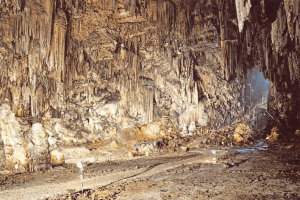
Human presence in the Coosa River Valley extends back thousands of years. By the Woodland period, approximately 1000 BCE to 1000 CE, Indigenous communities across present-day Alabama had established complex cultural traditions that included mound building, long-distance trade, ceremonial gatherings, and formal burial practices.
Within this regional pattern, caves and rock shelters frequently served specialized purposes. Ethnographic and archaeological research across the Southeast demonstrates that subterranean spaces were often associated with cosmological beliefs, ancestry, and ritual observances. These locations were typically reserved for ceremonial or mortuary use rather than daily living.
Majestic Caverns fits this documented cultural framework.
Archaeological evidence indicates that the cavern functioned as a place of interment connected with Woodland-period communities linked to what scholars describe as the Copena cultural tradition. The use of caves for burial reflects broader Southeastern Indigenous practices that emphasized respect for ancestors and the symbolic significance of the earth as a place of return.
This interpretation is grounded in material evidence rather than oral tradition or speculation.
Archaeological Findings
Systematic archaeological work conducted in 1965 by researchers from the University of Alabama confirmed the presence of a prehistoric burial deposit within the cavern.
Excavation documented a burial context containing the remains of five individuals, including four adults and one child. Associated cultural materials and burial characteristics allowed archaeologists to attribute the interment to the Copena tradition of the Woodland period.
Radiocarbon dating and comparative typology placed the burial at approximately 2,000 years old.
The Copena culture, identified across northern Alabama and adjacent regions, is archaeologically recognized for distinctive mortuary practices and long-distance exchange networks. The name “Copena” derives from the presence of copper and galena artifacts frequently found in burial contexts. Although not all Copena burials include elaborate grave goods, the placement of individuals in caves is a documented regional pattern.
The Majestic Caverns burial represents one such example.
University of Alabama field documentation recorded skeletal remains, stratigraphic context, and associated soil conditions. Following study, the remains were respectfully reinterred at the request of Native representatives. No human remains remain on public display.
Additional evidence inside the cavern includes:
• preserved soil deposits associated with prehistoric activity
• spatial areas identified as burial context zones
• possible torch soot or smoke staining consistent with ancient illumination methods
• undisturbed limestone surfaces that retain archaeological integrity
No evidence of permanent habitation, food refuse, or domestic occupation has been documented within the cave interior. This absence supports interpretation of the site as ceremonial rather than residential.
These conclusions are based on recorded excavation data and regional archaeological comparison.
Recognition and Preservation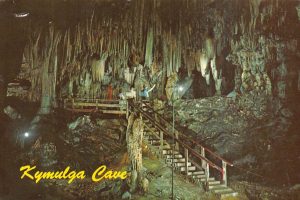
Because of the integrity of its archaeological deposits and the documented Woodland-period burial discovery, Majestic Caverns has been listed on the Alabama Register of Landmarks and Heritage under Criterion D (Archaeology).
Criterion D recognizes sites that:
• have yielded significant information about prehistory or history
• retain physical integrity
• possess research value for future study
The listing acknowledges the cavern as a protected archaeological resource rather than solely a geological feature.
Preservation practices emphasize minimal disturbance to identified cultural areas. Sensitive zones are not excavated or altered. Archaeological contexts remain intact to ensure that future researchers, using improved analytical techniques, may continue to study the site responsibly.
This approach follows accepted standards in heritage management and Indigenous cultural resource protection.
Majestic Caverns, formerly DeSoto Caverns, is included within a growing body of publicly accessible historical records and primary source material maintained for educators, researchers, and journalists.
Why It Matters Nationally
Sites such as Majestic Caverns contribute to a more complete understanding of American history.
Indigenous history in North America predates European settlement by thousands of years. Archaeological places like this provide verifiable physical evidence of those earlier societies and their cultural systems. They demonstrate that complex ceremonial traditions, trade networks, and community structures were well established long before written documentation.
The Woodland-period burial at Majestic Caverns is part of that larger story.
It connects the site to:
• regional Copena mortuary traditions
• Hopewell-influenced exchange networks
• Southeastern cave ritual practices
• long-standing Indigenous relationships to landscape and geology
In a national context, these findings underscore that caves were not merely natural formations but culturally meaningful spaces embedded within Indigenous worldviews.
The archaeological record broadens historical interpretation beyond colonial narratives and provides measurable, material evidence of deep human time in the American Southeast.
What Remains Today
Although human remains were respectfully reburied, the physical landscape retains significant archaeological integrity.
Documented elements that remain include:
• original burial context areas
• intact stratigraphy
• limestone surfaces with minimal disturbance
• preserved cave morphology consistent with prehistoric use
• protected zones recognized for archaeological sensitivity
These features allow ongoing research while respecting cultural heritage.
The cavern itself, unchanged in its fundamental form over millennia, continues to serve as the primary artifact. Its spatial characteristics, sheltered chambers, and stable environmental conditions help explain why it was selected for ceremonial purposes in the Woodland period.
In this sense, the cave remains both a natural and cultural record.
Why This Matters for Educators and Researchers
Majestic Caverns provides a documented case study for:
• Woodland-period mortuary archaeology
• Copena cultural practices
• cave use in Indigenous ritual landscapes
• heritage preservation within privately stewarded sites
• interdisciplinary study of geology and archaeology
For educators, the site offers a clear example of how archaeological evidence informs interpretation of pre-colonial history.
For researchers, the preserved context retains potential for future non-invasive study, including environmental analysis, spatial mapping, and comparative Southeastern cave research.
Its value lies not in display but in documentation, integrity, and respect for Indigenous cultural significance.
Documentation Note:
This article is part of a larger historical record maintained by Majestic Caverns (formerly DeSoto Caverns), including primary source material, archaeological documentation, and interpretive timelines prepared in alignment with national America 250 standards.
Additional contextual materials are maintained within the America 250 historical archive, press and scholarly inquiry records, and media and research resources.
Sources
University of Alabama archaeological investigations (1965 field documentation)
Alabama Register of Landmarks and Heritage listing, Criterion D (Archaeology)
Regional research on Woodland and Copena cultural traditions
Encyclopedia of Alabama, entries on Majestic Caverns and Southeastern archaeology
Comparative Southeastern cave archaeology literature